

If your teen needs therapy in a language other than English, there are a few common ways clinics make that happen. Most often, families end up with either a bilingual clinician who can provide therapy directly in your teen’s language, or an interpreter who joins sessions to translate between your teen and the therapist.
Sometimes there is also a hybrid setup, like a therapist who can do some direct communication in your teen’s language but uses an interpreter for accuracy and nuance, or a bilingual care coordinator who supports logistics and follow-through between sessions.
In many cases, a bilingual therapist is the smoother option because there is one fewer person in the room and less gets lost in translation. But an interpreter can still be a solid, ethical way to access care, especially when bilingual providers are scarce or the right clinical fit is otherwise hard to find.

What’s the real difference?
A bilingual therapist
A bilingual therapist can conduct the entire session in the language your teen is most comfortable using, switching languages when it helps. Your teen speaks directly to the clinician, and the clinician responds directly.
Who hears the session: typically just your teen and the therapist (plus you if you are invited in for part of the session).
A therapist with an interpreter
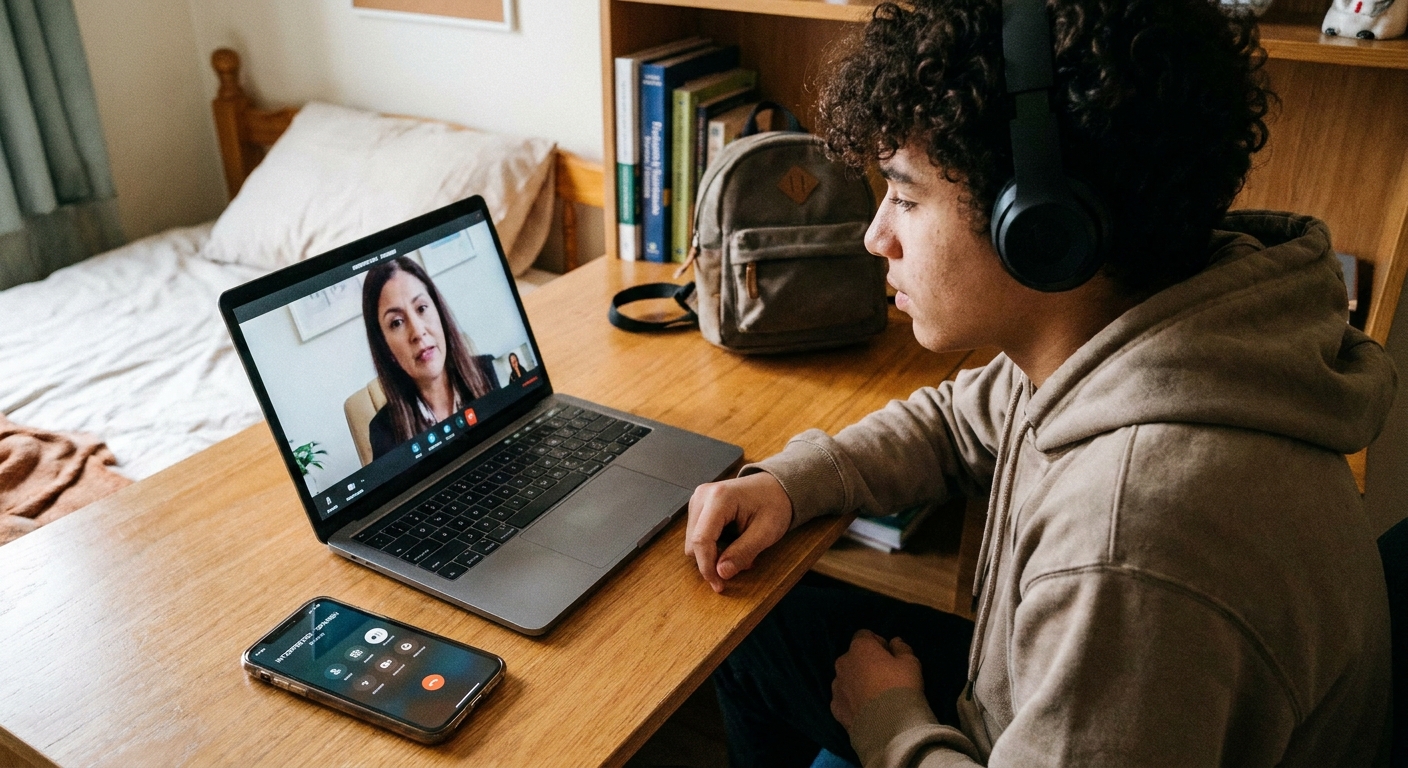
With an interpreter, there are three parties involved: your teen, the clinician, and the interpreter. Your teen speaks, the interpreter translates, and the therapist responds, then the interpreter translates back.
Who hears the session: your teen, the therapist, and the interpreter. In some settings, the interpreter may join by phone or video rather than in the room.
Neither choice is inherently “better.” The best choice is the one that gives your teen safe communication, accurate understanding, and consistent care.
Why many families prefer a bilingual clinician
When I worked with teens, I saw how quickly therapy can become about tiny details: the joke that didn’t land, the phrase that felt loaded, the one-word answer that meant “I’m fine” and also absolutely did not mean that.
A bilingual clinician can often:
- Move faster, because you are not pausing for translation every few sentences.
- Catch tone and subtext more easily, especially with humor, sarcasm, slang, and emotion words.
- Support code-switching, which is common in bilingual teens (they may tell the story in one language and name the feelings in another).
- Reduce self-consciousness for some teens who do not want a third person present.
Practically, it can also feel simpler for parents. You are coordinating one schedule, one person, one set of expectations.
One more nuance that matters: bilingual does not automatically mean bicultural. Language match can be huge, but your teen may also need someone who understands family roles, immigration stress, religion, racism, or community dynamics. It is okay to ask what populations the therapist has experience working with.
What an interpreter can do, and what they cannot do
A qualified mental health interpreter can be tremendously helpful. But their role is specific, and it matters to understand the boundaries.
What an interpreter can do
- Interpret accurately between languages, including helping clarify meaning when a direct translation does not exist.
- Support basic flow of a session so the therapist and teen can communicate.
- Reflect the speaker’s tone as faithfully as possible (for example, anger, uncertainty, sarcasm) without inserting their own viewpoint.
What an interpreter cannot do (and should not be asked to do)
- Provide therapy, coaching, or clinical advice.
- Decide what matters and what can be skipped. They should not summarize to “save time” unless the therapist explicitly requests it and your teen agrees.
- Take sides or mediate conflict between you and your teen.
- Keep separate secrets from the clinician. They are part of the clinical encounter, not a private confidant.
- Guarantee perfect translation. Even excellent interpreters sometimes have to ask for repeats or clarifications, especially with slang, trauma details, or rapid speech.
Privacy and confidentiality
Confidentiality is often the first worry parents have. It is also one of the most important questions to get answered clearly before the first appointment.
With an interpreter, confidentiality generally still applies, but details can vary by setting (a staff interpreter, a contracted interpreter, or a phone or video vendor). In most healthcare settings, interpreters are expected to follow confidentiality rules and professional ethics, but you should still confirm how your clinic handles it.
Here is what can change in real life:
- More people hear the content, which can feel more vulnerable for a teen.
- More systems may be involved if the interpreter is from an outside agency (scheduling, documentation, call logs, or platform access).
- Your teen may hold back about topics like sexuality, substance use, self-harm, dating, family conflict, or anything that feels shame-related or embarrassing.
A bilingual therapist reduces the number of listeners. That can make it easier for some teens to take the risk of being honest.
Either way, you can and should ask: who will be present, what the interpreter’s training is, and how privacy is protected.
How interpreted sessions feel
Interpreted therapy can work beautifully, but it is different. Expect the pace to be slower and for the therapist to speak in shorter segments.
Some teens adapt quickly. Others find the stop-and-start rhythm frustrating, especially if they are anxious, impulsive, or easily embarrassed.
If your teen is open to it, you can normalize the process before the first visit:
- “It might feel a little awkward at first because there will be pauses.”
- “You can tell the therapist if you want the interpreter on video instead of in the room, if that’s an option.”
- “If something doesn’t sound right in translation, you can say so.”
Questions to ask before you book
You do not need to interrogate anyone. A few targeted questions can tell you a lot about whether this clinic takes language access seriously.
- Is the therapist bilingual, or will we use an interpreter? If bilingual, ask what languages they provide therapy in (not just conversational ability).
- Is the interpreter trained in mental health settings? “Medical interpreter” experience helps, but mental health is its own skill set.
- Is the interpreter a professional, or will you ask us to bring someone? If they suggest family interpretation, you can request a professional instead.
- Will it be the same interpreter each session? Consistency matters for trust and for the teen not having to re-explain basics.
- How is confidentiality handled for interpreters? Ask whether interpreters are bound by confidentiality agreements and how they are vetted.
- Can the interpreter join by video or phone? Some teens prefer remote interpreting for privacy.
- How do you handle corrections? For example, if your teen says, “That’s not what I meant,” what is the process?
- Do you offer written paperwork in our language? Consent forms, privacy practices, and policies should be understandable.
- What happens if an interpreter is unavailable? Do you reschedule, switch interpreters, or ask to proceed in English?
- Is there any cost for interpreter services? Some clinics and health systems cover interpreter services, and some bill insurance. It is worth asking up front.
If you want more general screening questions for any therapist, you can also use: Questions to Ask a Teen Therapist Before You Book.
Red flags
You are allowed to be picky here. Poor language access can turn therapy into guesswork, and your teen deserves better than that.
- “We can just use Google Translate.” Translation apps can miss nuance, and they can raise privacy concerns. They are not appropriate for therapy sessions.
- “Have your teen translate for you,” or “Bring a sibling.” That is an unfair role shift and can create lasting family tension.
- The interpreter summarizes instead of interpreting without explanation.
- The therapist speaks in long paragraphs and seems annoyed by the pacing.
- Your teen looks lost and the therapist does not check for understanding.
- Confidentiality is vague, brushed off, or treated like a nuisance question.
If your teen refuses because of the interpreter
This happens more than parents expect. Teens often want privacy, and a third person can feel like a spotlight.
Here are a few small, realistic options to try:
- Ask about a bilingual clinician waitlist while starting with an interpreter now, if your teen is willing.
- Request the interpreter by phone so it feels less like “another adult in the room.”
- Ask for the same interpreter every time so your teen can settle in rather than re-evaluating trust each session.
- Offer a trial run: “Let’s do three sessions and then decide.”
- Name the awkwardness out loud and give your teen agency: “If it feels weird, we can problem-solve it with the therapist.”
If you are still at the stage of introducing therapy, start here: How to Tell Your Teen They Need Therapy. The language you use matters, especially when your teen already feels exposed.
When parent and teen languages differ
In bilingual households, it is common for a teen to feel best expressing emotions in English while a parent wants to speak in their first language, or the other way around.
Therapists can often structure this in a way that protects the teen’s privacy while keeping parents appropriately involved. For example, a parent check-in at the start in one language, then teen-only time in another.
If you are wondering how parent involvement typically works, this can help: How Parents Take Part in a Teen’s Therapy.
When speed matters more than perfect
Families sometimes pause care while they search for the “ideal” bilingual match. I understand why. You want this to feel safe and right.
But if your teen is struggling, starting with an interpreter can be far better than waiting with no support, especially if there are concerns about depression, anxiety, self-harm, trauma, substance use, or severe school refusal.
If your teen is in immediate danger or talking about suicide, seek urgent local help right away (emergency services in your area, or the nearest emergency department). Therapy logistics can be solved after safety is addressed.
If you are noticing signs that your teen needs more support at home while you line up care, you may find this useful: 7 Signs Your Teen Needs More Support at Home.
Bottom line
If you have access to a qualified bilingual therapist who is also a strong clinical fit, that is often the simplest and most comfortable route for teens.
If you do not, an interpreter is not a second-rate option. It is a legitimate, ethical accommodation that can open the door to real help, especially when the clinic takes training, consistency, confidentiality, and cultural fit seriously.
Your best next step can be small: pick two or three questions from the list above and ask them before you schedule. You are not being difficult. You are building the conditions your teen needs to actually talk.