
There is a particular kind of loneliness that can show up when you are technically married, technically loved, and still eating dinner alone for the third night this week. Frequent travel can turn a relationship into a relay race. One of you is running logistics at home, the other is running on airport coffee, and the handoff happens in rushed texts and half-awake phone calls.
The good news is that emotional intimacy often has more to do with felt connection than simple proximity. When I worked as a couples counselor, I used to call it “having a shared inner world.” You can build that across miles, but it usually takes intention, not just affection.
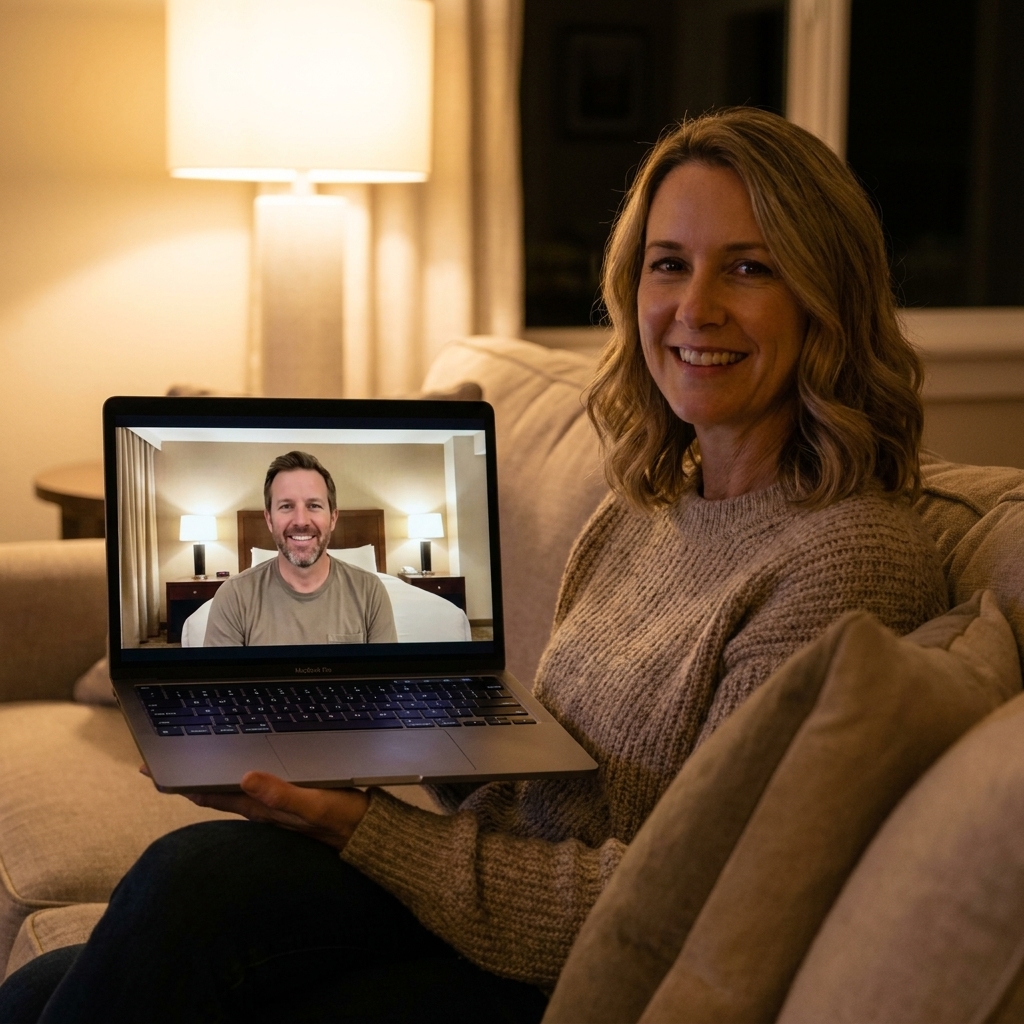
Start with the real issue
Most traveling couples do not struggle simply because they are apart. They struggle because they stop feeling known. When updates become status reports, intimacy dries up.
Try naming the pattern without blaming anyone. A simple reframe can change the tone immediately:
- Instead of: “You’re never here.”
- Try: “When you travel a lot, I miss feeling like we’re in the same emotional room.”
This keeps the issue focused on connection, not character.
Keep check-ins doable
When couples try to “fix” travel disconnection, they often swing big: hour-long calls, daily deep talks, elaborate plans. Those can be lovely, but they can also collapse the first time a flight gets delayed or a teenager has a meltdown at home.
Instead, aim for a rhythm that is predictable and doable.
The 10-minute anchor call
Pick one time window that works most travel days, even if it’s brief. Ten minutes is enough if it’s intentional. A structure helps:
- One highlight: “Something that went okay today was…”
- One low point: “Something that was hard was…”
- One bid for connection: “What I really need from you right now is…”
If you have more time, great. But this keeps you from defaulting to logistics only.
Asynchronous connection
If time zones and meetings make calls inconsistent, build connection through messages that don’t require perfect timing:
- A voice note that starts with “I’m thinking about you because…”
- A photo of something ordinary from your day, not just tourist shots
- A shared note where you both add “one thing I want you to know today”
Emotional intimacy often lives in the ordinary. Let your spouse see it.
Ask about the person
“How was your day?” is fine. It’s also the most efficient way to get “busy” as an answer.
Try questions that invite someone’s inner world. Rotate one or two a week so it doesn’t feel like an interview.
- “What felt heavy today?”
- “Where did you feel confident today?”
- “Did anything make you feel lonely?”
- “What are you looking forward to when you’re home?”
- “What’s one thing you wish I understood about this trip?”
If you want intimacy, ask about feelings, meaning, and needs. Facts are the appetizer. The inner life is the meal.
Practice micro-repair
Travel adds friction. Messages get misread. One partner feels abandoned, the other feels criticized. If you wait until the weekend reunion to address it, resentment often has time to ferment.
A micro-repair is a small, early move toward each other. It can be as simple as:
- “I think that text came out sharper than I meant. Can I try again?”
- “I felt a sting when you said that. I don’t want to store it up.”
- “I miss you and I’m also stressed. I’m not mad at you, I’m just maxed out.”
In my counseling years, I saw couples recover faster when they treated repair like brushing teeth. Not romantic, but profoundly protective.
Share the mental load
When one spouse travels, the at-home partner often becomes the household manager by gravity. Over time, that can erode intimacy because the relationship starts feeling like “employee and remote supervisor” instead of “teammates.”
Have an explicit agreement about who owns what, even during travel weeks. Ownership means you’re responsible for tracking, not just helping when asked.
- At-home partner owns: after-school logistics, pets, dinner plan
- Traveling partner owns: bills, scheduling the dentist, ordering pantry staples, calling the contractor
Adjust to fit your life. The point is to reduce the simmering sense of unfairness that makes it hard to feel tender.
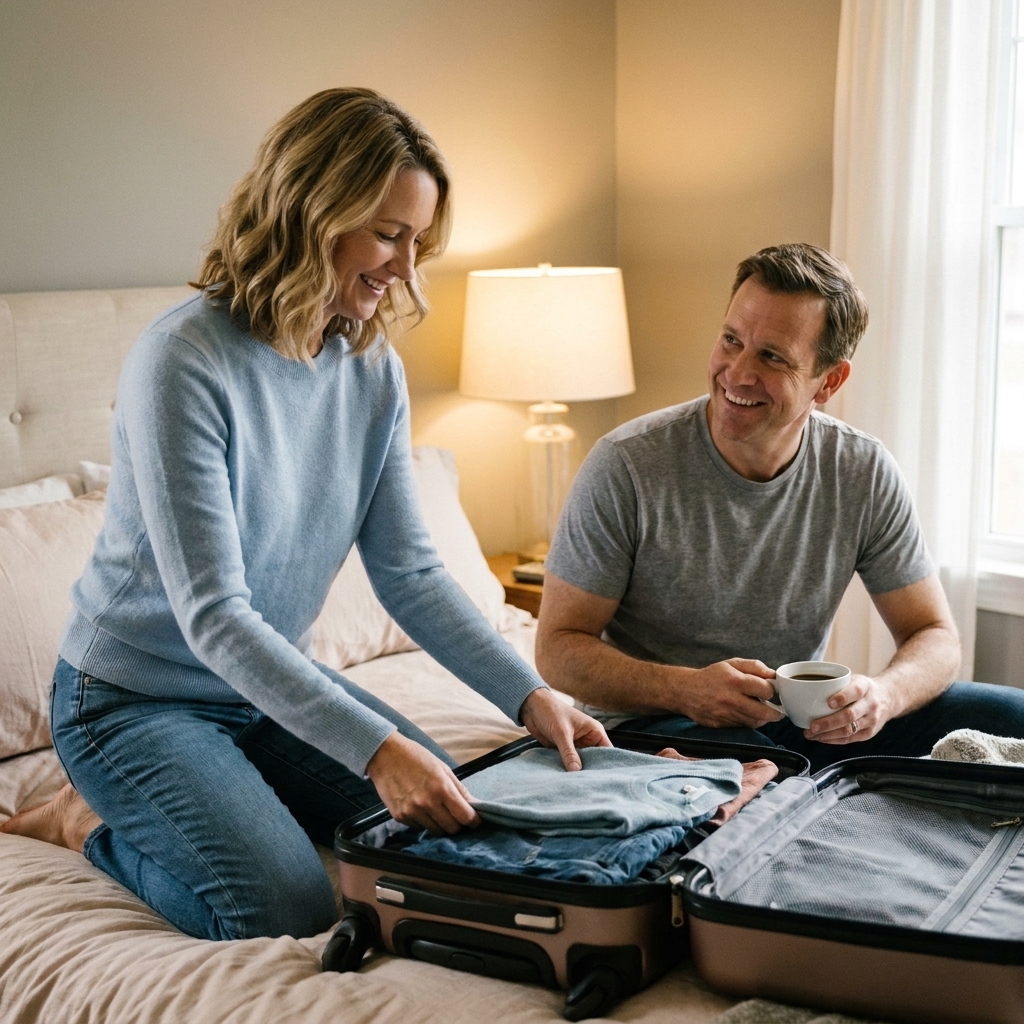
Try a no-logistics rule
Couples tell me, “We talk every day.” Then I ask what they talk about and it’s flights, kids, the dishwasher, and which credit card to use at Target.
Those things matter, but they don’t create much intimacy by themselves.
Try this rule: for the first five minutes of any call, no logistics. You can set a timer if you’re the kind of couple that finds that funny. Or necessary. Or both.
Then do logistics at the end, when your nervous systems are already settled.
Plan for real reunions
When travel is frequent, couples can start treating reunion like a movie scene. If it doesn’t feel magical, something must be wrong. In reality, reunions are often a mix of relief, awkwardness, exhaustion, and a fight over who forgot to buy milk.
Try planning for three layers of reconnection:
Layer 1: Gentle landing
- A hug that lasts long enough to breathe
- A quick debrief: “Anything urgent I should know before I unpack?”
- No problem-solving unless it’s truly time-sensitive
Layer 2: Real talk
Set aside 20 to 30 minutes after the first sleep. Ask:
- “What did you miss about us?”
- “What do you need this week to feel connected?”
- “Is there anything we should reset after this trip?”
Layer 3: Shared pleasure
Not a grand date night. A walk, a show you both like, coffee on the porch. Something that says: we are still a couple, not just a household.
Talk about sex early
Travel can create two common mismatches:
- The “starving” partner: has been missing touch and wants closeness immediately.
- The “fried” partner: is depleted from travel and needs sleep first.
Neither is wrong. But if you don’t talk about it, you can end up with a familiar script: one feels rejected, the other feels pressured.
Try a simple, non-loaded check-in:
- “When you get home, would you prefer a cuddle night or a spark night?”
- “Can we plan for closeness tonight and sex tomorrow?”
Emotional intimacy and physical intimacy tend to support each other, but they don’t always arrive in the same hour.
Build shared meaning
Research on long-term couples suggests that a sense of shared meaning and “we-ness” can be a strong predictor of resilience. Travel can interrupt that unless you intentionally create “us” moments.
Ideas that work for real-life couples:
- Read or listen to the same thing: a book, podcast series, or even a silly TV show. Then talk about it like you’re on the same couch.
- Shared rituals: Friday night dessert together on video, Sunday morning coffee check-in, nightly “three good things.”
- Small planning: one outing a month you plan together, even if it’s local.
When you can point to shared rituals, travel becomes a chapter in your relationship, not a pause button.

When travel hits a nerve
Frequent separations can stir up attachment needs, especially if you have a history of betrayal, near-separation, or simply a season where you felt emotionally alone. Sometimes what looks like “you never text enough” is really “when you disappear, I panic.”
If this resonates, go gently and name the vulnerable thing underneath:
- “When I don’t hear from you, my brain tells me I don’t matter.”
- “I know you’re busy, and I still need reassurance to feel steady.”
Then make a concrete plan: a quick goodnight text, a morning voice note, a calendar share. Reassurance isn’t childish. It’s relational glue.
Kids change the math
If you have kids, the at-home partner may be doing bedtime alone, managing emotions alone, and carrying the “background tasks” no one sees. That’s not just tiring. It can quietly drain tenderness.
Two small moves that help:
- Protect one adult moment: even if it’s 10 minutes after bedtime for a real check-in, not a household briefing.
- Let the traveling partner be a parent from afar: a short goodnight call, a recorded bedtime story, or a quick message to the older kid. It won’t replace presence, but it reduces the “it’s all on me” feeling.
Boundaries help, too
Connection shouldn’t require constant access. If one partner pushes for nonstop updates, the traveling spouse can feel monitored, and the at-home spouse can feel even more anxious.
Agree on basics that protect both connection and functioning:
- A consistent check-in window when possible
- A fallback plan for chaotic days: “If we can’t talk, can you send a quick goodnight?”
- Respect for sleep and work blocks unless it’s urgent
A weekly reset
Pick a day, keep it short, and treat it like preventative care. Twenty minutes. Same agenda each week:
- Schedule: What does travel look like this week?
- Load: What’s heavy at home and what can be shifted?
- Connection: When are we talking, and what do we want those calls to feel like?
- Appreciation: One specific thank you each.
You’re not trying to solve your entire marriage in one meeting. You’re trying to stay on the same team.
When it’s more than travel
Sometimes travel is not the problem. It’s the amplifier. If travel is being used to avoid conflict, to create distance, or to hide a second life, the usual “more check-ins” advice won’t touch the real issue.
If you’re dealing with secrecy, repeated lies, or ongoing fear about what’s happening on trips, prioritize safety and clarity. That might mean setting firmer boundaries, asking for transparency, or bringing in a couples therapist sooner rather than later.
Red flags
Some strain is normal. But there are signs the distance is starting to do damage that needs more support.
- You dread calls because they always turn into conflict
- You feel more relaxed when your spouse is away than when they’re home
- You stop sharing feelings and stick to logistics only
- Reunions are consistently tense or emotionally cold
- Either partner is using travel to avoid hard conversations
If you see yourself here, consider couples counseling, even short-term. Many therapists offer telehealth, which can be a surprisingly good fit for travel-heavy schedules.
FAQ
How often should we talk when one spouse travels?
Enough to feel emotionally oriented to each other, but not so much that it becomes another obligation. Many couples do best with a short daily anchor call plus a few affectionate texts or voice notes. Consistency matters more than duration.
What if my spouse is too exhausted to talk?
Believe the exhaustion and still protect connection. Try a “minimum viable” touchpoint: a 2-minute call to say goodnight, or a voice note they can listen to when they’re ready. Then schedule a longer call for a higher-energy day.
How do we avoid fighting during travel weeks?
You can’t avoid all conflict, but you can avoid escalation. Use micro-repairs quickly, avoid heavy topics at midnight, and save complex decisions for a planned time when both of you can think. Also, limit “tone guessing” over text. If it feels off, hop to voice.
I feel lonely and resentful. Is that normal?
Yes. Lonely and resentful often travel together because loneliness can feel unfair. Resentment is usually a signal that you need support, appreciation, or a more balanced load. Name it early and translate it into a request: “I need a predictable check-in,” or “I need you to own this task while you’re away.”
Can emotional intimacy really grow during a travel season?
It can. Many couples develop stronger communication, clearer rituals, and deeper appreciation when they treat travel like a shared challenge rather than a private burden.
A closing thought
If your spouse travels frequently, the goal is not to pretend you don’t miss them. Missing someone isn’t a failure of independence. It’s evidence that you’re attached, and attachment is the point.
Start small. Choose one new habit this week. Protect it like you protect your boarding pass. Emotional intimacy is built the same way families get through hard seasons: with steady, imperfect, loving repetition.