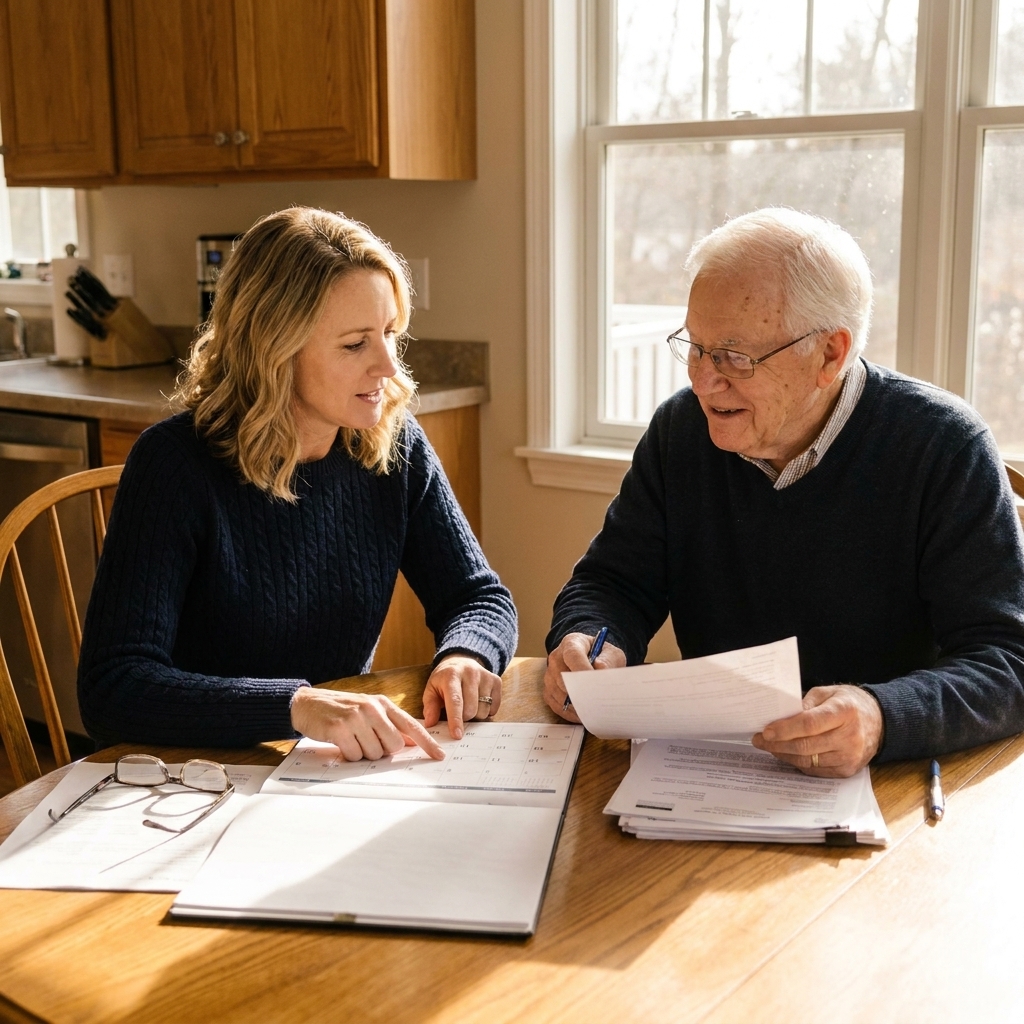
There is a particular kind of ache that shows up when you start thinking about assisted living for a parent. It is love mixed with fear, plus a pinch of role reversal that can make even the most capable adult child feel like a kid again.
If you have ever sat at a kitchen table trying to find the right words, you are not alone. You do not need perfect wording to begin. You need a plan, a calm moment, and a commitment to keep your parent’s dignity at the center of the room.

Below, you will find a step-by-step approach, what to avoid, and scripts you can adapt. Take what fits your family. Leave the rest.
Start with the real goal
Most families say the goal is “getting Mom to agree to assisted living.” Under that is almost always the real goal: improving safety and support while protecting autonomy.
If you lead with agreement, your parent may hear “surrender.” If you lead with values, your parent is more likely to hear “we are on the same team.”
Try this values-first opener
Script: “I want to talk about how we can keep you safe and also keep you in control of your life as much as possible. Can we think through some options together?”
That one word, “together,” matters. It signals partnership, not takeover.
Know the care levels
One reason these conversations get tangled is that families use the same words to mean different things. Here is a simple way to sort it out:
- Assisted living: Private apartment or room with help for daily tasks (like meals, bathing, medication reminders or management), plus social activities and transportation.
- Memory care: More structured support for dementia, with added supervision, secure spaces, and staff trained for cognitive changes. Often located within an assisted living community, but not always.
- Skilled nursing (nursing home): 24/7 medical care and rehab support for complex health needs, often after hospitalization or for ongoing high-level medical support.
You can be honest and still soften the fear. Sometimes simply clarifying, “I’m talking about assisted living, not a nursing home,” lowers defenses enough to keep talking.
Pick the right moment
Timing is a major factor in how this conversation goes. If you bring it up during a fall recovery, after a scary driving incident, or in the middle of a family holiday, you are asking everyone’s nervous system to do acrobatics.
Best conditions for a hard talk
- Neutral day: not immediately after a crisis.
- Private, familiar place: kitchen table beats a hospital hallway.
- Earlier in the day: especially if your parent sundowns or gets tired in the evening.
- One or two people: avoid the sibling pile-on.
- Clear agenda: “Today is just to talk, not decide.”
A simple framing that helps
Script: “This is not a one-time conversation. I want to start talking now so we are not forced into decisions later.”
When you emphasize planning, you lower the temperature.
Do a quick reality check
You do not need a binder that could qualify as a small textbook. But you do need a grounded picture of what is happening, otherwise the conversation becomes a debate over impressions.
What to gather in advance
- Safety concerns: falls, wandering, medication mix-ups, stove incidents.
- Health changes: hospitalizations, memory shifts, mobility decline.
- Daily living: bathing, meals, laundry, driving, bills.
- Current support: who is helping, how often, and what is slipping.
- Financial basics: what is realistically affordable.
If you can, write down 3 to 5 specific examples with dates. Not to prosecute your parent. To avoid the painful loop of “You are exaggerating” versus “No, I am not.”

Use a simple script formula
When emotions run high, structure helps. This approach is inspired by common conflict-resolution and nonviolent communication frameworks, adapted for real families who are tired.
The formula
- Observe: share a concrete fact.
- Feel: name your emotion without blame.
- Need: state the underlying need or value.
- Ask: make a specific, doable request.
Example script
Script: “I noticed you have fallen twice in the past month, and the last time you were on the floor for a while. I feel scared when I think about you alone at night. I need to know you have help quickly if something happens. Would you be willing to tour two communities with me next week, just to see what support looks like?”
Notice what is missing: “You can’t handle this anymore.” Even if it feels true, it tends to trigger shame and resistance.
Expect grief to show up
Moving to assisted living is not just a logistics decision. It is a grief event, even when it is the right choice. Your parent may be grieving a home, a neighborhood identity, a role, a spouse, or simply the ability to say, “I don’t need help.”
Sometimes grief walks in wearing a bad disguise:
- Anger: “You’re trying to get rid of me.”
- Minimizing: “It’s no big deal. Everybody forgets.”
- Humor: “Just put me on an ice floe and wave goodbye.”
- Control battles: “I will do it my way or not at all.”
Your job is not to win the argument. Your job is to keep the conversation human.
Scripts for objections
Use these as starting points. Change the words until they sound like you.
“I’m not going to a nursing home.”
Script: “I hear you. I am not talking about a nursing home right now. I am talking about assisted living, which is more like having support available while you still have your own space. Would you be open to seeing one so you can tell me what you like and what you don’t?”
“I’m fine. You’re overreacting.”
Script: “I hope I am overreacting. Truly. But I can’t ignore what we’ve seen. When you missed your blood pressure medication twice this week, it scared me. Can we look at options that would make that easier and safer?”
“I’m not leaving my house.”
Script: “This house holds so many memories. I would never pretend that leaving is easy. If staying here were as safe and supported as we both want, I would be relieved. Can we compare what it would take to stay safely at home versus what assisted living offers?”
“I can’t afford that.”
Script: “Money matters. Let’s not guess. Can we sit down together and look at the real numbers, including what you are already paying for the house, utilities, food, and help? Then we can see what is possible.”
“You just want my house.”
Script: “I’m really glad you said that out loud, because that fear is heavy to carry. This is not about your assets. It’s about your safety and my ability to sleep at night. If it helps, we can bring in a neutral third party to talk through finances.”
“I’ll lose my freedom.”
Script: “Freedom is a big value for you, and I respect that. Right now, a lot of your freedom is being limited by emergencies and recovery days. What if we aimed for the kind of support that gives you more good days and fewer crises?”
When cognition is changing
If dementia is part of the picture, the conversation needs a different shape. Logic and evidence often do not land the way you want. Repeating “You forgot” can create humiliation, which tends to increase resistance.
Guidelines that help
- Keep it simple: one idea at a time.
- Use reassurance more than persuasion: “You’re safe. I’m here.”
- Offer two choices, not ten: “Do you want to visit on Tuesday or Thursday?”
- Anchor in comfort: favorite chair, familiar blanket, family photos.
- Get medical backup: ask the primary care provider, neurologist, or another clinician to document safety concerns when appropriate.
If safety is escalating, ask about a capacity evaluation in your area. A clinician’s assessment can guide care planning, but it is not always the same as a legal determination of capacity. If legal decision-making is unclear, consider consulting an elder law attorney about power of attorney, guardianship, or next steps.

When assisted living is not enough
Sometimes the most loving choice is admitting that assisted living may not match the level of need. It can help to name that possibility early, so you are not scrambling later.
Common signs you may need more care
- Frequent falls, especially with injuries or inability to get up safely
- Advanced dementia with wandering or unsafe exits (elopement risk)
- Complex medical needs that require frequent skilled nursing care
- Behavioral symptoms that cannot be supported safely in an assisted setting
- Unsafe medication use despite support
If you are seeing these patterns, ask facilities directly what they can and cannot safely manage. The right fit is not about willpower. It is about matching support to reality.
Keep siblings aligned
Families have a special talent for reopening old roles under stress. The “responsible one” gets resentful. The “far away one” gets defensive. The “it will all work out” one disappears until decision day.
Two moves that reduce conflict
- Separate the parent conversation from the sibling negotiation. Do not hash out family resentment in front of your parent.
- Use shared criteria. Agree on the decision points first: safety, staffing, proximity, budget, culture fit.
A script for siblings
Script: “I’m not asking you to agree with my feelings. I’m asking you to help us agree on a plan. Can we pick three criteria that matter most, and then divide up research and tours?”
If your sibling dynamics are complicated, a geriatric care manager or family mediator can be worth the cost.
Offer a trial
One reason assisted living talks go off the rails is that parents hear permanence. If it is appropriate for your situation, a trial period can reduce fear and create real data.
Ways to frame a trial
- Short stay or respite program (commonly a few weeks, sometimes 1 to 4 weeks depending on the community).
- A lease with a clear review date.
- “We’ll reassess after you’ve had time to settle.”
Script: “What if we treat this like trying on a pair of shoes? Not a forever decision today. Just enough time to see if you feel safer and less stressed.”
What not to say
I know. You have said the same thing so many times you could recite it in your sleep. Still, certain phrases almost guarantee a power struggle.
- “You can’t live alone anymore.” Try: “Living alone is getting riskier, and we need more support in place.”
- “You’re being stubborn.” Try: “This is scary. I get why you’re pushing back.”
- “If you loved me, you’d do this.” Try: “I love you, and I’m worried. Let’s find a plan that respects you and keeps you safe.”
- “This is for your own good.” Try: “Here’s what I’m seeing, and here are the options as I understand them.”
Assisted living is not a parenting moment. It is a partnership moment, even if the partnership is imperfect.
A 14-day plan
If you are overwhelmed, borrow this simple structure. Momentum helps.
Days 1 to 3: clarify the why
- Write down 3 specific safety concerns.
- Identify your parent’s top values (privacy, faith community, pets, independence).
- Choose your opening line and one clear request (tour, budget talk, doctor visit).
Days 4 to 7: gather options
- Pick 2 to 3 communities within your budget range.
- Ask about staffing, medication support, transportation, and levels of care.
- Request a sample calendar and menu.
Days 8 to 14: tour and debrief
- Tour with your parent if possible.
- Let your parent talk first afterward.
- Schedule a follow-up conversation within 48 hours while impressions are fresh.

Costs and payment basics
Cost is often the unspoken stressor behind the whole conversation. A few high-level notes can prevent surprises:
- Many assisted living communities are private pay and charge a monthly base rate plus added fees based on care needs.
- Long-term care insurance may help, depending on the policy.
- Medicaid rules vary by state. In many areas, it may help cover some care services but not room and board. Ask what applies where you live.
- VA benefits (including Aid and Attendance) may apply for eligible veterans or spouses. Eligibility and amounts vary.
If money is tight or complex, it can help to talk with a financial advisor familiar with elder care, a benefits counselor, or an elder law attorney before you tour. Clarity reduces conflict.
Questions to ask on a tour
You are not being picky. You are being protective.
- How do you assess care needs and adjust support over time?
- What is your process after a fall or medical event?
- How is medication managed, and who administers it?
- What does a typical day look like for someone who is not super social?
- How do you handle memory concerns if they arise later?
- What are the move-in costs, monthly costs, and potential add-on fees?
- How do families communicate with staff, and how often are care plan meetings?
- Do you share staffing ratios or staffing levels, and if so, how are they measured?
If your parent says no
A “no” is not always the end. Sometimes it is a request for pace, control, or more information.
Three follow-up approaches
- Ask what part is hardest: “What worries you most about it?”
- Offer smaller steps: “Could we start with in-home help twice a week?”
- Name your boundary: “I can’t keep doing overnight checks. We need another layer of support.”
If safety is urgent, you may need to move from conversation to action. That can include a doctor’s assessment, an in-home safety evaluation, a driving evaluation, or involving a care manager. It is still love, even when it is firm.
Culture and family roles
Not every family approaches aging the same way. In some cultures, multigenerational households are the norm. In others, independence is the highest value. Sometimes one sibling is expected to carry the load because of gender, birth order, or geography.
Use the scripts in this guide as building blocks, not rules. Keep the heart of the message the same: respect, safety, choice, and a plan that your family can actually sustain.
When guilt hits you
Let me say the quiet part out loud: deciding about assisted living can make you feel like you are betraying someone you adore.
But support is not abandonment. It is a form of devotion that has outgrown what one person can provide.
If you are making this decision because you want your parent safer, more supported, and less alone, you are not failing. You are responding to reality.
One grounding question I often used with caregivers is this: If my parent were looking at me, what would they want for my life? Most parents do not want their child’s marriage, health, or finances to collapse in the name of loyalty.
FAQ
What if my parent refuses assisted living but is not safe?
Start by documenting specific risks and involving their physician. If cognitive impairment may be present, ask what evaluation options exist in your area. If needed, consult an elder law attorney about legal options. In immediate danger, prioritize safety and involve emergency services.
How do I talk about assisted living without taking away dignity?
Lead with values, offer choices, and ask for collaboration. Avoid shaming language. Focus on support, not punishment. Include your parent in tours, decisions, and personalizing their new space.
Is it better to say “assisted living” or “senior community”?
Use whichever term your parent can hear without shutting down, as long as you stay honest about the level of support. Sometimes “community” opens the door, and you can clarify care details as you go.
How long does it take for someone to adjust?
Many people need weeks to a few months. The first month can be the hardest. Familiar routines, regular visits, and bringing meaningful items from home can help.
A closing note
This conversation is not just about a building or a floor plan. It is about how a family chooses to care for one another when life changes the rules.
Go slowly when you can. Be firm when you must. Keep coming back to the same message: “I love you. I am worried. I want us to find a way forward together.”