

When a child is young, “talk therapy” can feel like an odd fit. Many kids do not have the words for the feelings they are carrying, and even when they do, they often cannot access those words on demand in an office with a new adult.
That is why play therapy is so commonly recommended for preschool and early elementary kids. It is not “just playing.” It is a developmentally appropriate way for a child to communicate, practice coping skills, and build a safe relationship with a therapist.
One important note, because this is a common point of confusion: play therapy is a specific, trained approach. Lots of therapists use toys, games, and drawing to help kids feel comfortable. That is not automatically the same as providing a play therapy model.

Play therapy vs. talk therapy
Play therapy uses play, art materials, stories, games, pretend, movement, and sensory tools as the primary “language” of the session. Your child communicates through what they choose, how they play, what themes show up, and how they respond when things feel hard.
Talk therapy relies more on conversation, questions, answers, and verbal reflection. For young children, talk-based work often still includes some play or drawing. It is just less central.
Neither approach is automatically better. The question is what matches your child’s age, temperament, needs, and the therapist’s training.
Age and developmental fit
In general, play-based approaches are often a strong fit for ages 3 to 8, with plenty of exceptions. Some very verbal 5-year-olds do well with more conversation, and some 9-year-olds still need play as the easiest path into feelings.
If you are unsure where your child lands, pay attention to this: do they process with words when they are upset, or do they communicate through behavior, movement, and reenacting?
What play therapy looks like
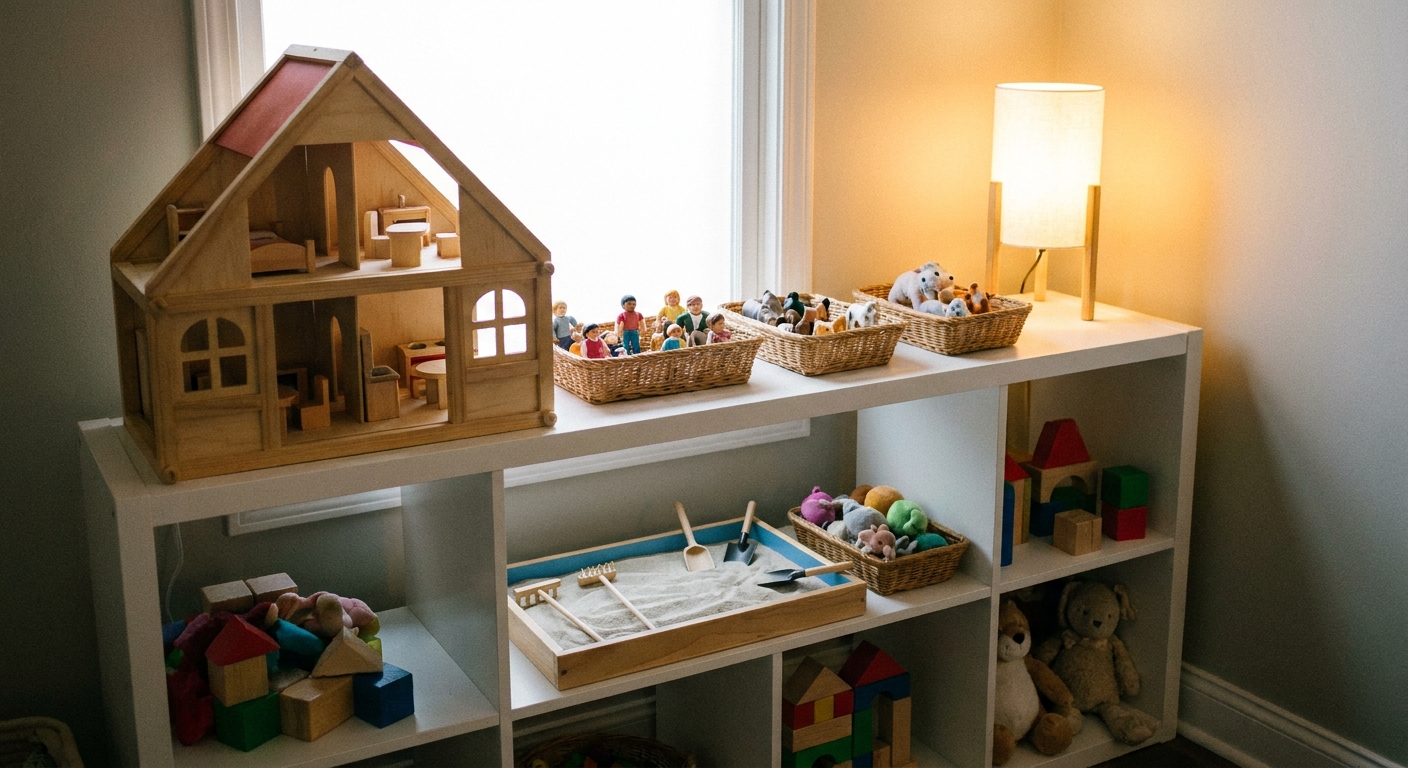
Most play therapy rooms look a bit like a carefully curated playroom. The therapist is not trying to entertain your child. They are watching for patterns, emotional themes, coping attempts, and how your child uses the relationship in the room.
A typical session
- Warm-up and settling in: Your child explores the room or chooses an activity. The therapist tracks and reflects what they see in simple language.
- Child-led play: Depending on the model, the therapist may follow your child’s lead or gently structure the play toward a goal (like practicing calm-down skills).
- Skill building inside play: The therapist may practice naming feelings, tolerating frustration, asking for help, taking turns, or using coping tools, all embedded in play.
- Transition out: The therapist helps your child shift to leaving, sometimes with a predictable routine. Many kids struggle most at transitions, so this matters more than it sounds.
- Brief parent check-in: Often 5 to 10 minutes to share themes and next steps, without violating your child’s privacy.
Play therapy can be especially helpful when a child shuts down under questions, becomes silly or dysregulated when anxious, or has big feelings that come out as behavior.
What talk therapy looks like
Talk therapy for young kids can be more structured and more therapist-led, especially in skills-based models. That said, it depends on the modality and the clinician. Some work that is “talk-based” is still quite child-led, and many therapists blend conversation with play in a way that feels natural.
A typical session
- Check-in: The therapist asks simple questions about school, friends, sleep, worries, and feelings.
- Activity with conversation: Drawing, a game, blocks, or a storybook while talking. This “side-by-side” format often helps kids talk more naturally.
- Practice a coping tool: Belly breathing, “worry time,” feeling charts, safe place imagery, or a simple plan for what to do when upset.
- Wrap-up: Review of one takeaway and how to practice it at home.
Talk-based work can fit well when a child is older (early elementary and up), verbally expressive, curious about emotions, or specifically working on skills like problem-solving, worry thoughts, or social situations.
Do parents stay in the room?
This is one of the biggest practical differences, and it is also one of the most emotional for parents. It is hard to hand your child over and not know exactly what is happening.
Common setups
- Parent stays for the whole session: Common for very young kids, separation anxiety, or when parent coaching is the main focus.
- Parent joins for part of the session: The therapist may start with you present, then have you step out for 20 to 30 minutes, then bring you back for a summary and a home plan.
- Child meets alone and parent gets a short debrief: Common when the therapist is building a private, secure space for the child, with regular parent check-ins.
- Parent sessions without the child: Very common in evidence-based work for child behavior and anxiety, including parent coaching models. Many child therapists do a mix of child sessions and parent sessions.
There is no universal rule that “good therapy” means you are always in the room or always out of it. The therapist should be able to explain why they recommend a particular structure and how they will keep you meaningfully involved.
Which one helps which struggles?
Therapy is not a vending machine where you select “anxiety” and press “play therapy,” but certain patterns do tend to fit certain approaches.
Play therapy is often a strong fit when
- Your child is preschool or early elementary and has limited emotional vocabulary.
- Your child freezes, hides, or gets silly when asked direct questions.
- Big feelings show up through behavior, meltdowns, aggression, or regression.
- There has been a stressful event and your child reenacts themes in play (control, danger, rescue, separation).
- Your child needs help with emotional regulation, not just insight.
Talk-based sessions are often a strong fit when
- Your child likes to explain and narrate their world.
- Your child can reflect on thoughts and feelings with some support.
- The goals are skill-focused (worry coping skills, friendship problem-solving, school stress).
- Your child prefers predictable structure and clear “what we do in therapy” routines.
If you are seeing anxiety signs and you are unsure whether it is “enough” for therapy, you may also want to read 5 Signs Your Child Is Struggling With Anxiety.
When specialized care matters
Sometimes the real decision is not play versus talk, but which specialized approach your child needs. For example, a child with trauma symptoms may be recommended a trauma-focused model, and a child with significant sensory needs may benefit from a therapist who is neurodiversity-affirming and comfortable coordinating with occupational therapy supports when appropriate.
You do not need to sort this alone. A good intake should clarify what the therapist is treating, what model they use, and what they will do if your child needs a different level of support.
How to choose without overthinking
As a former family therapist, I will tell you the quiet truth many parents need to hear: fit matters more than labels. A skilled child therapist will often blend modalities and will adjust as your child grows.
- Start with your child’s communication style: Do they process out loud, or do they show you through actions?
- Ask what the therapist does when your child will not engage: This is where training shows.
- Consider the main goal: Emotional expression, coping skills, behavior support, processing a change, family stress, or school issues.
- Prioritize parent involvement: Not “control,” but collaboration. You should understand the plan and your role in it.
- Give it a short runway: Many kids need a few sessions just to feel safe enough to show their real selves.
What to ask before booking
You deserve clear answers. A good child therapist will not be offended by thoughtful questions.
Questions about the approach
- What does a typical session look like for a child this age?
- Is the play child-led, therapist-led, or a mix?
- What specific training do you have in play therapy with young children?
- How do you measure progress in a way that makes sense for a young child?
Questions about parent involvement
- Will I be in the room? If not, how will you help my child separate and feel safe?
- How often do you meet with parents, and what do those meetings cover?
- How do you handle confidentiality with young children while keeping parents informed?
Questions about goals and timeline
- What goals would you suggest after an intake, and what would we do at home between sessions?
- When would you expect to reassess whether this approach is a good fit?
- What would make you recommend a different level of care or a different type of evaluation?
If you are new to the therapy world and want more general guidance on vetting a provider, this teen-focused checklist still has useful parent questions that translate well to younger kids: Questions to Ask a Teen Therapist Before You Book.
What progress can look like
With young children, progress is often subtle at first. It can look like shorter meltdowns, faster recovery after tears, fewer stomachaches before school, or a child who can accept comfort again.
In play therapy specifically, you might hear the therapist talk about themes shifting over time. For example: play that used to be frantic and dangerous becomes more organized, or a child who always played “power battles” begins to practice asking for help.
It is also normal for things to feel a little wobbly early on. Opening feelings can temporarily increase clinginess or irritability, especially if your child is finally letting their guard down in one safe place.
If your child refuses to go
Young children often resist therapy for the same reason they resist dentist appointments. It is unfamiliar, it interrupts routine, and they do not get to control it.
Try a low-pressure explanation
You can keep it plain and honest:
“We are going to meet someone whose job is to help kids with big feelings and tough days. There will be toys and games. You do not have to talk about anything you do not want to. I will be close by.”
If your child is anxious about separation, ask the therapist in advance how they handle first sessions. Many will build up gradually rather than forcing a hard drop-off.
When to reconsider
It is reasonable to give a new therapy relationship a few sessions, especially with shy kids. It is also okay to change course if something feels off.
Consider reassessing if
- Your child is consistently terrified before every session and it is not easing over time.
- You cannot get a clear explanation of the goals or what the therapist is doing.
- The therapist blames your child for not participating, rather than adjusting the approach.
- You feel shut out completely, with no meaningful parent involvement or guidance.
- Concerning behaviors are escalating and the plan is not being updated.
If you are juggling family stress while trying to support your child, it can help to ground the whole household with a few conflict-reduction basics. This partner-focused piece is surprisingly useful for co-parents and caregivers too: 10 Tips to De-escalate a Heated Argument With Your Partner.
FAQ
Is play therapy evidence-based?
Some forms are supported by research, particularly structured models and approaches that include parent work. The more important question is whether the therapist can clearly explain the model they use, how it fits your child’s needs, and how they track progress.
Will my child just play and never talk about the problem?
Many young children do not talk directly about the problem at first, and that can still be meaningful therapy. Over time, a skilled play therapist helps translate play themes into emotional skills and real-life coping, often with parent support in parallel.
How long does therapy take?
It depends on the goal, the stressors in your child’s life, and how consistently support happens at home and school. Your therapist should offer a working plan and revisit it as you go, rather than keeping things vague indefinitely.
What if I want skills for home, not just insight?
Say that out loud in the first call. Many child therapists blend play with parent coaching and concrete routines, especially for anxiety and behavior struggles.