

A teen psychological evaluation can sound intimidating, even when you know you are doing the right thing. Most appointments are simply structured conversations plus problem-solving tasks and questionnaires. There is usually nothing dramatic about the day, but it can be long and a little tiring.
Here is the most common flow: you check in and handle paperwork. The psychologist meets with you and your teen (together and separately). Your teen completes standardized tasks and questionnaires (for example, measures related to learning, attention, memory, or mood). There are breaks. In many cases, you leave without a final diagnosis or fully detailed plan in hand. A written report and a feedback appointment typically come later, and some practices also offer a same-day verbal summary of next steps.

What an evaluation is (and is not)
A psychological evaluation is a structured way to understand how your teen is functioning emotionally, behaviorally, socially, and academically. The evaluator gathers information from multiple sources so they can answer the referral questions as clearly as possible.
It is not a pass or fail test, and it is not designed to label your teen. It is also not usually a same-day verdict on medication, school placement, or custody decisions. That said, an evaluator may make same-day safety recommendations if something urgent comes up, and the final report may later be used in conversations with schools or in legal contexts even though the evaluator is not the one making those decisions.
Why teens are referred
Families are often referred for evaluation when the same concern keeps showing up in more than one setting, or when it is not clear what is driving the behavior.
Common referral questions include (as examples): attention or executive functioning concerns (including ADHD), anxiety or depression symptoms, possible learning differences, social communication concerns (including autism traits), trauma and stress reactions, or a confusing mix of school, mood, and behavior changes.
These are starting points, not conclusions. The goal is clarity, not a label hunt.
Psychologist vs neuropsychologist
Some teens are evaluated by a psychologist, and some by a neuropsychologist. Both can do testing, but neuropsychological testing often goes deeper on how brain-based skills like attention, memory, processing speed, and executive functioning connect to learning and daily functioning.
If you are not sure which type of assessment fits your questions, Neuropsychological vs Psychological Testing for a Teen can help you sort out what to ask.
How to prepare the week before
You do not need to “train” your teen for testing. In fact, trying to coach answers can make results less useful. What helps most is practical preparation and a clear, low-pressure explanation.
- Confirm logistics. Ask how long the visit is expected to take, what to bring, and whether there will be breaks.
- Gather records if requested. This might include school reports, prior evaluations, IEP or 504 paperwork, teacher notes, or therapy summaries.
- Sleep and food. Encourage decent sleep and a normal breakfast or lunch. Bring snacks and water if allowed.
- Medication instructions. If your teen takes medication, follow the evaluator’s guidance about whether to take it as usual that day. Do not stop or change prescribed medication unless the prescribing clinician has explicitly told you to.
- Comfort items. A hoodie, fidget item, or stress ball can help some teens regulate during long sessions.
If your teen is anxious about the appointment, you might find it helpful to review how to talk about support in a non-threatening way in How to Tell Your Teen They Need Therapy. The same tone works well for evaluation day too: calm, specific, and not loaded with fear.
What to bring
Clinics vary, but a simple checklist can prevent a stressful scramble:
- ID and insurance card if the practice requests them.
- Glasses, contacts, or hearing aids your teen uses for school.
- Snacks and water if allowed.
- Any requested forms or prior reports (IEP/504 documents, report cards, past testing).
- A phone charger for you, and ask ahead about teen phone rules during breaks.
Checking in and the first 15 minutes
Most offices start like any medical or counseling visit: paperwork, consent forms, and privacy notices. You may be asked to verify contact information and who can receive the final report.
Sometimes a staff member will do a brief intake first, then the psychologist will introduce themselves and explain the plan for the day. Your teen should hear, in plain language, what will happen next and when breaks are available.
Who is in the room
Parents often worry they will be asked to sit in the room for the whole evaluation, or that they will be shut out completely. Usually it is a mix.
Common setups
- Parent interview alone: You meet with the evaluator without your teen present for part of the time.
- Teen interview alone: Your teen meets with the evaluator without you present for part of the time.
- Joint time: Some evaluators start or end with everyone together to review goals and next steps.
It is normal for the psychologist to want private time with your teen. That is not a sign you are being blamed. It is often the best way to get honest answers, especially on sensitive topics like mood, friendships, substances, sexuality, or self-harm.
What testing looks like
People often use “testing” as shorthand, but it is only one part of the broader evaluation. The testing portion can feel mysterious because it is not one single test. It is usually a battery of tools chosen to match the referral concerns.
Your teen may be asked to do a mix of the following:
- Talking and answering questions about mood, stress, sleep, appetite, friendships, school, and family life.
- Pencil-and-paper or digital questionnaires with statements like “I worry a lot” or “I feel restless,” rated on a scale.
- Problem-solving tasks like patterns, puzzles, vocabulary, memory questions, or timed activities.
- Attention and impulse-control tasks that can feel repetitive or boring on purpose.
- Emotional or behavioral screeners designed to look for symptom patterns.
Some teens describe parts of testing as “weirdly like school,” and other parts as “like a long interview.” Both are accurate.
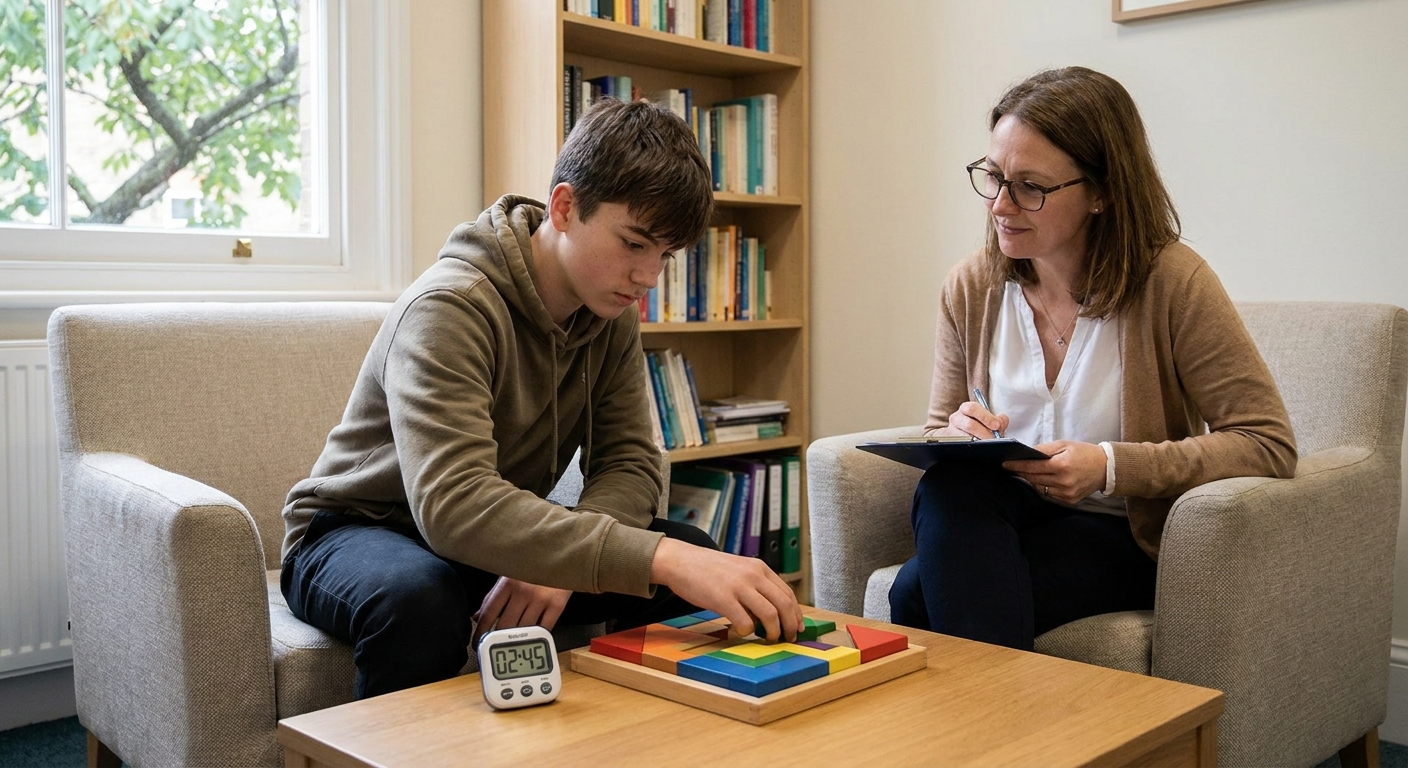
How long it takes
Timing varies by the clinic and the questions being answered. Many psychological evaluations take several hours of face-to-face time, and some are split into multiple appointments.
Even if testing is completed in one day, the work behind the scenes takes longer. Scoring, interpreting patterns, reviewing records, and writing a thorough report is time-intensive.
If your teen fatigues easily, ask ahead of time whether the evaluation can be split across sessions. A tired teen is not a “bad” teen. It is a human one.
Breaks and phones
On a practical level, the small policies can make or break your teen’s comfort.
Questions to ask ahead of time
- How often are breaks offered, and can my teen request one?
- Can they bring water or a snack?
- Are phones allowed during breaks, or should we leave them in the car?
- What happens if my teen becomes overwhelmed or shuts down?
- Is there a quiet waiting area for parents?
For many teens, knowing they can take a short break without “getting in trouble” reduces anxiety more than any pep talk.
Parent questionnaires
You may be asked to complete rating scales about attention, mood, behavior, adaptive skills, or family functioning. Sometimes another caregiver, a teacher, or a school counselor is asked to fill out a form too.
This can feel vulnerable, especially if you and your teen see things differently. Try to answer as accurately as you can, based on patterns over time rather than the worst week you have had recently.
If you are unsure what a question means, it is appropriate to ask. “Do you mean at home, at school, or both?” is a fair clarification.
School coordination
Many evaluations include school-relevant recommendations, like classroom supports or accommodation ideas. The report can be helpful in school meetings, but it does not automatically grant services. Schools typically have their own eligibility processes.
If you want the psychologist to speak with the school, share records, or attend a meeting, that usually requires your written consent (and sometimes your teen’s consent depending on age and local rules). If you are considering school coordination, Can Your Teen’s Therapist Attend an IEP Meeting? can help you think through what is realistic to request.
What is not decided that day
Many families leave testing day hoping for immediate certainty. Most of the time, the evaluator will not give final answers at the end of the appointment, even if they have strong early impressions.
Here are common things that are often not finalized on testing day:
- A formal diagnosis.
- Medication decisions.
- Eligibility determinations for school services.
- A final treatment plan with specific providers and schedules.
- A full written report.
What you might hear at the end
Even when the psychologist cannot share full conclusions yet, many will offer a brief roadmap of what happens next. You might hear:
- How long the report will take.
- Whether there will be a separate feedback session.
- Any urgent safety concerns that need same-day attention.
- General recommendations while you wait, like school check-ins or therapy support.
If you are leaving with unanswered questions, it is okay to ask for clarity on the process, not the conclusions. Process questions are usually easier to answer right away.
Results and timeline
Most evaluation processes include a follow-up appointment where the psychologist reviews findings, explains what the results mean in plain language, and answers questions. Then the written report is provided, either before or after that meeting depending on the practice.
Report turnaround times vary widely. Some practices can turn a report around in a week or two, while others may take several weeks (or longer during busy seasons). It is reasonable to ask for the expected timeline in advance so you can plan school meetings and follow-up care.
In a good feedback session, you can expect the evaluator to:
- Connect results back to the original concerns.
- Explain strengths as well as struggles.
- Differentiate between what they are confident about and what is still unclear.
- Offer recommendations that match your teen’s real life, not just a list of resources.
After a long day
Even confident teens can feel wrung out afterward. The evaluation can be mentally demanding, and the questions can bring up emotions they did not expect.
- Keep the schedule light. If possible, avoid stacking sports practice, tutoring, and a family meeting right after.
- Offer decompression, not a debrief. Try: “Do you want to do something quiet, or get food?” before: “So, what did you say about your anxiety?”
- Thank them for showing up. Effort matters, especially if they were reluctant.
- Watch for a delayed crash. Some teens get irritable or teary that evening. That can be fatigue, not failure.
If your teen refuses
This happens more than most parents realize. A teen can want help and still feel exposed by the process.
If you see resistance, you can keep it simple and respectful:
“You do not have to love this. I am asking you to do it because we need better information. We can take it one step at a time, and you can ask for a break.”
If your teen refuses to continue, the evaluator may pause, reschedule, or shift to less demanding tasks. A skilled psychologist can often gather useful information even when a teen is guarded.
If you are in the middle of ongoing conflict at home, you may also find it helpful to read House Rules With Teenagers Without Power Struggles for language that reduces escalation while you navigate next steps.
When safety comes up
Sometimes an evaluator asks directly about self-harm, suicidal thoughts, or substance use. This can be alarming for parents to hear about, but it is also a routine part of responsible assessment.
If your teen reports an immediate safety risk, the psychologist should address it right away. That might include creating a safety plan, recommending urgent evaluation, or involving you in a same-day conversation about supervision and support.
Common parent questions
Will my teen fail if they are anxious or do not try hard?
There is no pass or fail. Evaluators look at effort, consistency, and patterns across measures. Anxiety and fatigue are themselves meaningful data, and they are usually noted in the interpretation.
Should I tell my teen to do their best?
Yes, gently. I usually recommend something like: “Just answer honestly and do the tasks the way you normally would.” Pressure to perform can backfire.
Will the evaluator tell me everything my teen says?
This varies a lot by state or country, your teen’s age, clinic policy, and the consent and custody situation. Many evaluators aim to share themes and safety issues, not every detail, but you should ask directly how confidentiality works in that specific practice.
If you want to understand the common boundaries parents run into, What Can a Therapist Share With Parents of a Teen? can help you know what to ask.
What if I disagree with the results?
You can ask questions and request clarification. It is appropriate to say, “This does not match what we see at home, can you help us understand how you reached that conclusion?”