

Walking into your first couples counseling session can feel like showing up to a job interview with the person you love most and the person you argue with most. It is vulnerable, and it is normal to be nervous, defensive, hopeful, or all three at once.
Here is the simplest truth: the first session is mostly about orientation and assessment. You are not expected to resolve years of hurt in a typical first appointment that lasts under an hour. You are there to help the counselor understand what is happening, what matters to each of you, and what a safer, more productive process could look like.

What happens in the first 5 to 10 minutes
Most first sessions start with logistics. Expect the counselor to cover confidentiality, policies, and how the session will run so there are fewer surprises once emotions show up.
Common early items include:
Paperwork review (consent forms, contact info, fees, cancellations, telehealth rules).
Confidentiality basics and legal limits (for example, safety concerns).
How the therapist handles communication in session (taking turns, no interrupting, what happens if voices rise).
Clarifying the goal for today: “By the end of this session, what would feel like a good use of your time?”
If you are worried about getting “in trouble” for what you say, it can help to remember: the therapist is not a judge. They are listening for patterns, pain points, and what each of you needs in order to feel emotionally safe enough to do the work.
How confidentiality works in couples counseling
Confidentiality in couples work can be a little different than individual therapy, and it is worth asking about it in session one.
In particular, therapists vary in how they handle secrets shared privately. Some have a no-secrets policy (meaning they will not hold information that materially affects the relationship). Others handle it case by case, with clear guardrails.
You can ask directly: “If one of us tells you something privately, how do you handle that?” A clear answer early on helps both partners feel safer participating.
Will we be seen together or separately?
In many practices, partners are seen together for the first session. The therapist wants to understand how you communicate in real time and to hear each person describe the relationship in their own words.
That said, models differ. Some therapists prefer individual intakes first, especially if there are safety concerns, very high conflict, or complicated histories to screen for.
Some therapists also schedule brief individual check-ins either during the first appointment or soon after. Others do a full “couples intake” together and keep sessions conjoint unless there is a specific reason not to.
What it might look like
All together the whole time: You both share what is bringing you in, and the therapist begins setting goals and structure.
Together, then short individual time: The therapist may meet with each person for 10 to 15 minutes to hear concerns that are hard to say in front of a partner.
Separate first, then together: Less common, but sometimes used when conflict is high or one partner is very anxious about starting.
How long it lasts and how it is paced
A first couples session is often 50 to 60 minutes, though some clinicians schedule longer intakes (60 to 90 minutes). If the appointment is standard length, the therapist will pace it to avoid opening something painful without enough time to settle.
That pacing can feel frustrating if you arrived with a long list. But it is often intentional. Session one is frequently about:
Getting a clear snapshot of the relationship and your current stressors.
Reducing immediate volatility so you can keep showing up.
Choosing one or two priorities to start with, rather than ten.
Intake questions you can expect
Couples counseling intake questions can feel personal fast. That is because the therapist is trying to understand both the problem and the context the problem lives in.
Here are common question areas.
What brought you in now
“What made you decide to come in at this point?”
“Has something changed recently?” (an affair, a new baby, a move, caregiving, job loss)
“What have you already tried?”
How conflict typically goes
“What do you fight about most?”
“What happens in your body when conflict starts?”
“When does it calm down, and how?”
Strengths and what is still working
“What do you appreciate about your partner?”
“When do you feel closest?”
“What made you choose each other?”
History that affects the present
How long you have been together, major turning points, and past attempts to repair.
Family background, previous relationships, and how conflict was handled growing up.
Big life stressors, including parenting and caregiving pressures.
Practical factors that can fuel disconnection
Sleep, work schedules, money stress, health issues, parenting load, technology habits.
Sex and physical intimacy concerns, if relevant.
It is okay to say, “I need a moment,” “I am not ready to share that today,” or “Can we come back to this when we have more time?”
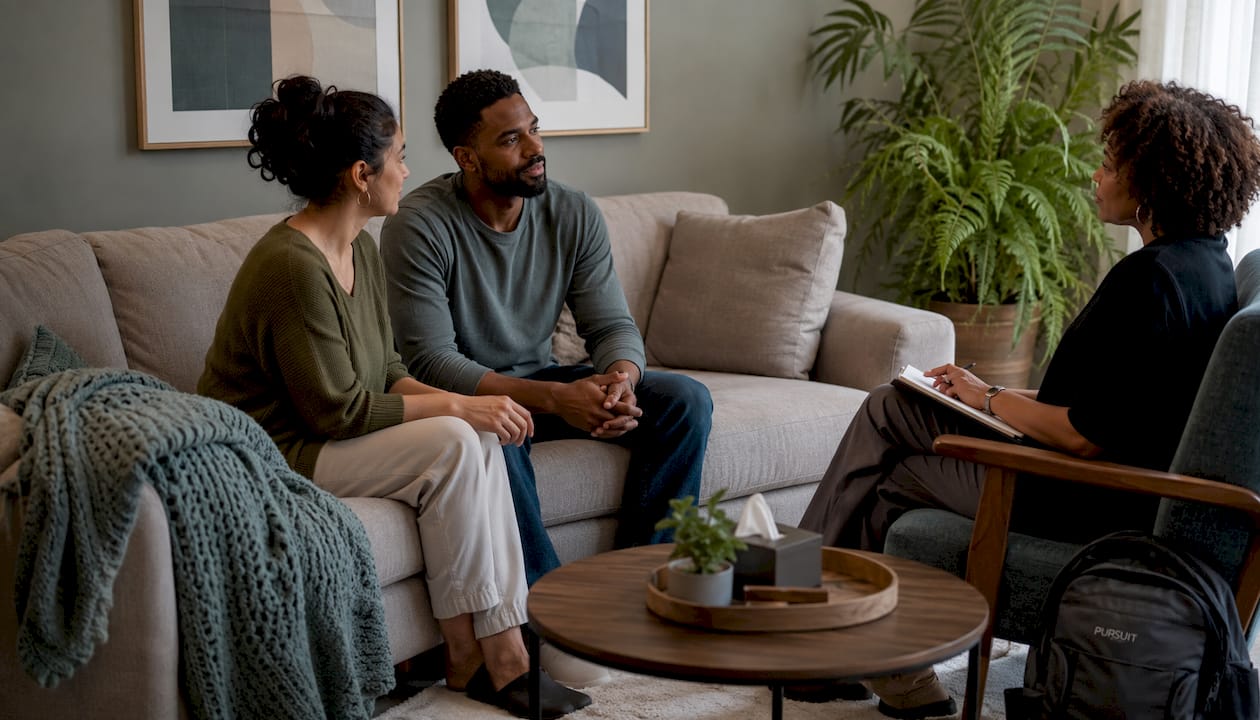
What the counselor is assessing
While you are talking, the counselor is listening for more than content. They are also paying attention to the process.
Some of what they are quietly assessing:
Your interaction pattern: pursue and withdraw, criticize and defend, shut down and explode, over-explain and dismiss.
Emotional accessibility: can each of you name feelings beyond anger, and can you hear your partner’s feelings without attacking them.
Safety and stability: whether sessions can be productive without escalating harm.
Motivation and goals: are you both here to repair, to decide, to co-parent better, or because someone issued an ultimatum.
Barriers: active addiction, untreated trauma, severe depression, an ongoing affair, constant contempt, or external stressors that are swallowing the relationship.
This is not about diagnosing your relationship as “good” or “bad.” It is about figuring out what kind of roadmap makes sense and what should come first.
Sometimes that roadmap includes parallel support, like individual therapy, substance use treatment, medication evaluation, or a medical checkup for sleep or mood. That is not a failure. It is the therapist trying to stabilize the ground so couples work can actually stick.
How the therapist will manage conflict
Many couples worry, “What if we start fighting right there?” That is a real fear. It is also common. Therapists expect it.
In a first session, you might see the counselor do things like:
Slow you down: “Let’s take that one sentence at a time.”
Redirect from blame to impact: “When that happened, what did it mean to you?”
Balance airtime: making sure one partner does not dominate while the other disappears.
Name the pattern: “I’m noticing a loop where one of you reaches and the other protects.”
Set immediate ground rules: no name-calling, no threats, no interrupting.
If you want a helpful warm up beforehand, Kinfolds has a practical guide on calming things down in the moment: 10 tips to de-escalate a heated argument with your partner.
What will not be settled
It helps to walk in with realistic expectations, especially if you are exhausted and desperate for relief.
Most first sessions will not fully resolve:
Whether you should stay together or separate.
The entire story of betrayal, years of resentment, or a long-standing intimacy issue.
Deep agreements about parenting, in-laws, or finances.
A perfectly fair “who is right” verdict.
The first appointment is more like laying track than arriving at the destination.
What to do before you walk in
You do not need a speech. A little preparation can make the session feel less chaotic, though.
Pick one example of a recent conflict you can describe in 2 to 3 minutes, start to finish.
Name one hope you have for counseling that is about the relationship, not just your partner changing.
Decide your boundary: what you are not ready to discuss in detail yet.
Plan the car ride home: a pause, a coffee stop, or a simple agreement like “no debrief for 30 minutes.”
A few quick logistics many couples wonder about:
Bring notes if you want: a short list can help you stay focused, but you do not need to present a case.
Do not bring kids, unless the practice explicitly asks you to. Most couples intakes are adults-only.
Telehealth vs in-office: online sessions can work well, but ask about basics like privacy (headphones, separate spaces) and what the therapist prefers if one of you gets overwhelmed.
If you are struggling to put your needs into words without starting a fight, this may help: how to ask for more emotional support from your partner.
Useful scripts for session one
When emotions spike, most of us revert to our usual role: prosecutor, defender, or quiet retreat. Having a few simple lines ready can keep you grounded.
If you feel blamed
“I want to understand what landed for you. Can you tell me the impact, not just what I did wrong?”
“I’m getting defensive. I want to stay in this conversation, but I need it slowed down.”
If you feel flooded or shut down
“I’m starting to shut down. I need a minute to breathe so I can keep listening.”
“I hear this matters. I can talk about it, but I need us to take turns.”
If you are afraid of saying the wrong thing
“I’m nervous to say this because I don’t want it to turn into a fight.”
“This is hard to talk about at home. That’s why I wanted a therapist in the room.”
If you are not sure you even want to be there
“I’m not sure what I want yet. I’m willing to be honest and show up today.”
“Part of me hopes this helps, and part of me is tired. Both are true.”

How the session ends
Near the end, the therapist will usually summarize what they heard and suggest a direction for the work. This might sound like:
“Here is the cycle I noticed when you get stuck.”
“These are the 1 to 2 goals I suggest we start with.”
“Here is what I want you to practice between now and next time.”
The “between session” task is often small: a communication reset, a 10 minute daily check-in, or tracking what triggers escalation. If the therapist gives you homework that feels impossible, you can ask to scale it down. A smaller practice done consistently beats a grand plan no one can sustain.
If you are wondering whether you are in the right place at all, you might also read couples therapy vs relationship coaching for a clearer sense of what counseling is designed to do.
When to speak up
You are allowed to have preferences about pacing and structure. Couples counseling works best when the process feels fair enough that both people can risk honesty.
Consider speaking up if:
You felt repeatedly interrupted and it was not addressed.
The session escalated and there was no plan to stabilize.
You left feeling afraid of retaliation at home.
You do not understand the plan, frequency, or goals.
You can say something as simple as:
“Before we end, can you tell us what you think the main pattern is, and what you want us to focus on first?”
If you are still deciding whether counseling is the right step, Kinfolds also covers common indicators in 7 signs it’s time for couples counseling.